
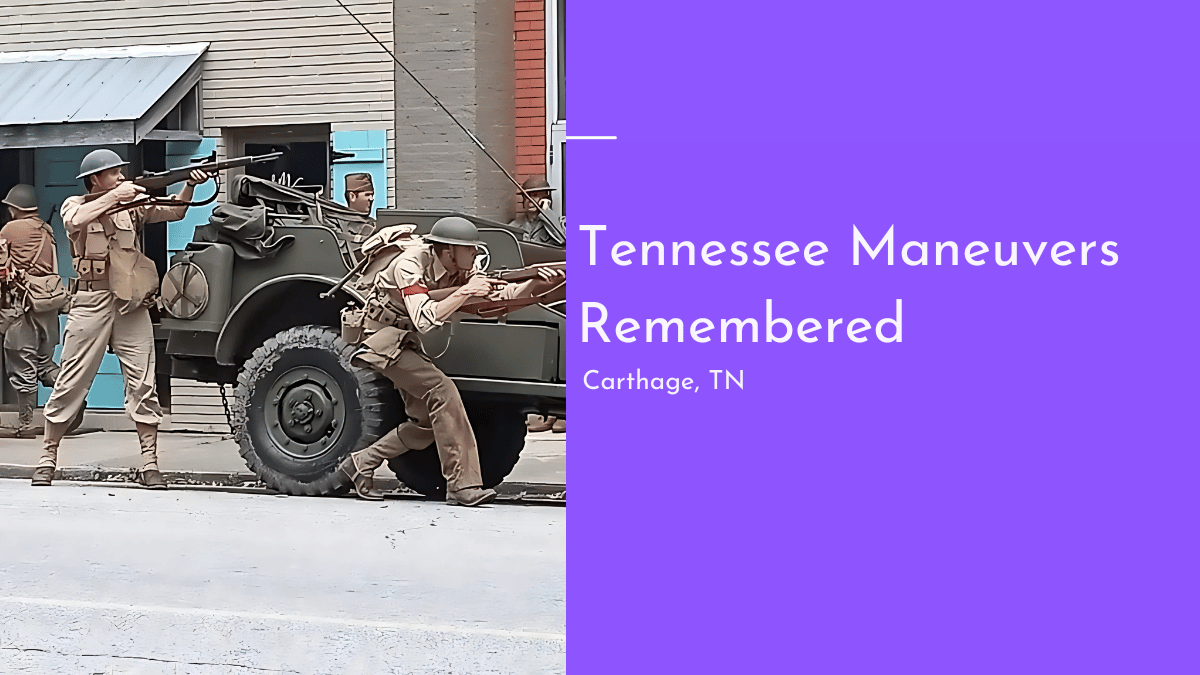
On Saturday, May 2, 2026, downtown Carthage will feel less like a quiet Tennessee town and more like a living page from American history.
For one day, the Historic Smith County Courthouse lawn and the nearby streets will fill with military vehicles, reenactors in period uniforms, wartime artifacts, 1940s music, and the sounds of a Red vs. Blue battle reenactment. From 10 a.m. to 4 p.m., visitors will be able to step into a version of the past that feels vivid, personal, and close enough to touch.
That is the spirit behind Tennessee Maneuvers Remembered, the free public event hosted by the Smith County Historical Tourism Society. Now returning for its sixth year, the event has become more than a local attraction. It has grown into a reminder that one of the most important chapters of World War II history did not begin overseas. Part of it began right here in Middle Tennessee.
Many Americans know the broad story of World War II. They know about D-Day, the Battle of the Bulge, and the long road to Allied victory in Europe. What far fewer people know is that before many of those soldiers ever reached foreign soil, they trained on Tennessee farms, roads, fields, and backcountry routes. The Tennessee Maneuvers helped prepare American forces for modern war, and Smith County was part of that effort.
That forgotten history is exactly what this event is designed to bring back into focus.
Each year, Tennessee Maneuvers Remembered turns history into something visitors can walk through. It is not a museum exhibit behind glass. It is an experience. Families can see military and homefront displays, watch live demonstrations, ride in period vehicles, and hear the sounds and music of the 1940s. Children can engage with history in a way that feels real instead of distant. Adults can connect the familiar streets of Carthage to events that helped shape the outcome of a global war.
One of the event’s driving forces is founder Tressa Bush, whose work has helped keep the history of the Tennessee Maneuvers alive for new audiences. Over the years, she has helped turn a regional story into a growing community tradition, one built not only on facts and artifacts, but also on memory.
“When I get discouraged, I remember the smiles on the faces of all the people I’ve interviewed as they thanked me for allowing them to share their memories of the most historic events to ever take place in Middle Tennessee, the Tennessee Maneuvers,” Bush has said.
That sense of memory is at the heart of everything the event tries to do. It is not just about uniforms, vehicles, or reenactments. It is about giving voice to a period that still lives in family stories across the region.
To understand why this matters, it helps to go back to the early years of World War II.
In 1939, the United States Army was not ready for modern combat. It ranked 17th in the world and had just over 200,000 regular army troops. Much of its equipment still dated back to World War I. Then Germany invaded Poland in September of that year, and the world changed quickly. Fast-moving ground units, tanks, and air power were redefining warfare. The United States needed to adapt, and it needed to do so fast.
Between 1941 and 1944, the Army carried out seven massive field exercises across 21 counties in Middle Tennessee, including Smith County. More than 850,000 soldiers trained during the Tennessee Maneuvers. They came from 25 divisions, including infantry, armored, and airborne units. Of those divisions, 24 later fought in Europe, while another went on to serve in the occupation of Japan.
The Army based its field headquarters at Cumberland University in Lebanon, while Camp Forrest near Tullahoma served as a major support site. Soldiers trained on real landscapes, not artificial practice grounds. They crossed rivers, moved through small towns, defended highways, and launched attacks across working farmland. The Army split units into Red and Blue forces, then used umpires to judge outcomes. Bridges could be ruled destroyed. Supply lines could be cut. Entire units could be declared casualties based on the conditions of the exercise.
The War Department saw Middle Tennessee as the ideal training ground for several reasons. The region had access to railroads and airports. Its population was sparse enough to support large exercises. It already had two National Guard camps nearby, Camp Campbell and Camp Forrest. Just as important, military leaders believed the rolling hills, rivers, open fields, and country roads looked enough like parts of Europe to prepare American troops for the kind of fighting they would soon face in France, Belgium, and Germany.
But the maneuvers did not only shape the Army. They changed local life too.
Farmers signed agreements allowing troops to cross their land. Tanks and trucks damaged fences, crops, and fields, though the Army paid claims for those losses. On weekends, soldiers poured into towns like Carthage. They filled restaurants, stores, hotels, and theaters. Churches and civic groups hosted meals, dances, and services. Some soldiers even fell in love during their time in Tennessee. For local families, the war effort was no longer something happening far away. It was rolling down country roads and passing right by the front porch.
The final maneuvers ended in late March 1944, just months before D-Day. Even now, many Smith County families still tell stories about tanks moving past homes, soldiers marching across farmland, and the excitement of watching history unfold in real time.
That lasting local memory helps explain why Tennessee Maneuvers Remembered continues to grow.
This year’s program will once again feature military and homefront history displays, educational booths, authentic military and period vehicles, artifact exhibits from Allied and Axis groups, WWII plane flyovers, 1940s entertainment, and vehicle rides. One of the biggest attractions will be the Red vs. Blue battle reenactment on Main Street, which gives visitors a dramatic glimpse into the kind of training that once defined the region.
Organizers also plan to display rare wartime items such as helmets, rifles, mess kits, sweetheart letters, and other pieces of daily military life. Those objects matter because they reveal the human side of war. They show not just what soldiers carried, but what they felt, saved, used, and brought with them through a world in crisis.
The event is designed with families in mind. In past years, hands-on activities and living history scenes have helped younger visitors connect with the past in ways that feel engaging rather than formal. That balance between education and experience is one reason the event has earned such a loyal following.
Admission is free, and no ticket is required, though organizers encourage visitors to register through the official Eventbrite page for updates and any last-minute schedule changes. The Smith County Historical Tourism Society’s Facebook page and event group will also share updates. Parking will be free in downtown Carthage, within easy walking distance of the event area. The event will be held rain or shine, although the plane flyovers will depend on the weather.
Visitors are encouraged to wear comfortable shoes, bring sunscreen and water, and even dress in 1940s-inspired clothing if they want to lean into the atmosphere of the day.
This year’s event is sponsored by Nyrstar, whose support helps make Tennessee Maneuvers Remembered possible and also brings added attention to local tourism, businesses, restaurants, and shops in Smith County.
For Bush and the volunteers behind the event, the mission goes well beyond a single Saturday. The Society continues its work year-round through oral history interviews, an eight-stop self-guided driving tour with QR-coded locations across Smith County, and plans for a documentary tied to the 80th anniversary of V-E Day.
That larger effort is what gives the event its weight. Tennessee Maneuvers Remembered is not simply a reenactment. It is an act of preservation. It is a way of keeping local stories from fading. It is a reminder that before American troops helped change the course of history overseas, many of them first learned how to fight on the roads and fields of Middle Tennessee.
On May 2, Carthage will once again become a place where the past feels present. Visitors will hear the music, see the vehicles, meet the reenactors, and walk through a story that helped prepare America for one of the defining battles of the twentieth century.
For a few hours, history will not feel far away at all.